WHAT IS AN OPEN-ENDED FUND & HOW TO TRADE IT?
"If you want to invest in the stock market but lack the time to monitor daily price boards, or lack the expertise to select individual stocks/bonds, an Open-Ended Fund is the perfect solution for you."
WHAT IS AN OPEN-ENDED FUND & HOW TO TRADE IT?
If you want to invest in the stock market but lack the time to monitor daily price boards, or lack the expertise to select individual stocks/bonds, an Open-Ended Fund is the perfect solution for you.
1. What is an Open-Ended Fund?
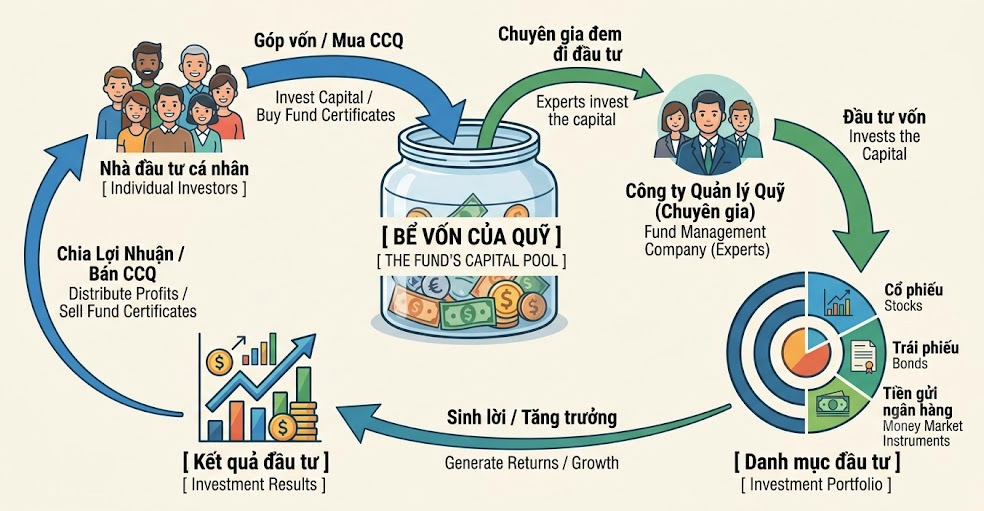
An open-ended fund is a form of collective investment scheme. It pools money from multiple individual investors who share similar financial goals into a massive capital pool.
The defining feature is that this pool is professionally managed by a Fund Management Company. Financial experts use this capital to invest in a diversified portfolio of stocks, bonds, or money market instruments to generate returns for you.
Why is it called "Open"?
Open-ended timeframe: The fund has no fixed maturity date. You can join at any time.
Open-ended capital: There is no limit on the number of investors or the number of fund certificates issued.
Open-ended liquidity: You can sell your fund certificates back to the fund management company whenever you need cash.
2. How an Open-Ended Fund Operates
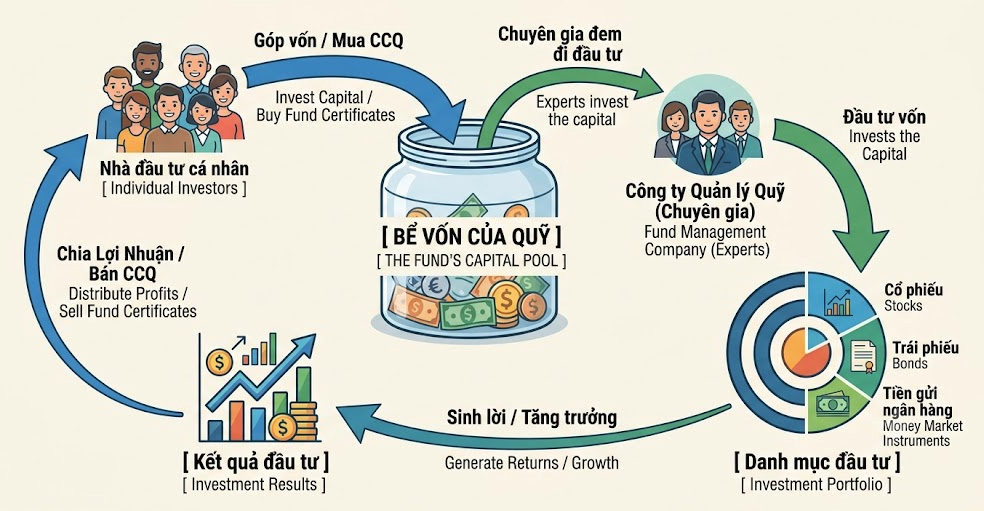
To easily visualize how it works, take a look at the cash flow cycle below:
3. How to Trade Open-Ended Funds?
Trading open-ended funds nowadays is incredibly simple and can be done 100% online via the fund management company's app or distribution agents (such as banks, securities firms, or wealth-tech apps).
Step 1: Open a Fund Account
Register an account with a Fund Management Company or an authorized distribution platform. Identity verification (eKYC) takes only a few minutes.
Note for FundLab: Since FundLab is an investment simulation platform, the account opening process is much simpler and faster, as eKYC is not mandatory.
Step 2: Place a Buy Order (Investing)
Choose a fund that matches your risk appetite (Equity Fund for high risk - high return; Bond Fund for safety).
Transfer your investment amount to the Fund's bank account held at the Supervising Bank.
Your money will be converted into Fund Certificates based on the NAV per unit (Net Asset Value per fund certificate) determined on that trading day.
Step 3: Monitor and Grow
The fund managers handle the rest. You only need to track your asset growth through the app. You can also opt for a Regular Investment Plan (SIP) with a very small amount monthly.
Step 4: Place a Sell Order (Redemption)
When you achieve your financial goals or need cash, simply place a Sell order. The fund management company is legally obligated to buy back your fund certificates at the current NAV price. The money will be transferred directly to your bank account within a few business days.
4. Top Benefits of Investing in Open-Ended Funds
Low Capital, High Diversification: With just a small amount of money, you can instantly own a slice of a portfolio containing dozens of top-tier stocks.
Safety & Transparency: Funds are strictly overseen by a custodian bank and the State Securities Commission.
Professional Management: Your money is managed by top-tier financial minds, saving you time and stress.